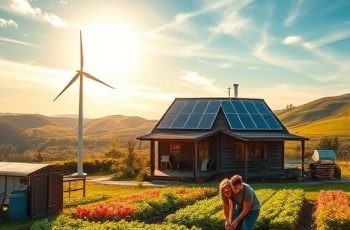
Four categories cover the essential systems most off-grid transitions need to address: power, water, food, and the practical skills that keep the other three running. This blueprint focuses on what each category actually requires, not just that it matters.
Power
Sizing starts with a real load calculation — adding up watt-hours per day for every device and appliance — rather than a generic system size. A basic setup covering essential loads (lighting, refrigeration, communication, small electronics) typically needs a few kW of solar panels, a battery bank sized for at least 2-3 days of autonomy without sun, a charge controller, and an inverter to convert stored DC to usable AC. Wind or a backup generator commonly supplements solar in regions with significant seasonal daylight variation or extended cloudy stretches.
Water
A realistic daily estimate (roughly 7-13 gallons per person for drinking, cooking, and basic hygiene) drives both sourcing and storage decisions. A well, rainwater catchment, or spring — ideally more than one, since single-source systems have no redundancy — paired with filtration rated for the actual contaminants present (sediment, bacteria, and depending on region, agricultural or naturally occurring chemical contaminants) covers the sourcing side; food-grade storage sized for at least a two-week reserve covers the backup side. A well isn’t a “test once and forget it” system — the EPA notes that roughly one in five private wells nationally has at least one contaminant above a health-based benchmark, which is why an annual retest matters even after an initial clean result.
Food
A combination of production (garden, small livestock) and preservation (root cellar, canning, dehydrating, fermenting) reduces dependence on frequent resupply trips without requiring full self-sufficiency from day one. Starting with a small garden and one or two preservation methods, then expanding, is more realistic than attempting a complete food system immediately — most successful transitions build food capacity over one to several growing seasons, not instantly.
Skills
Basic maintenance and repair — for solar equipment, water systems, small engines, and structures — determines how self-reliant a property actually is versus how dependent it remains on outside help for routine problems. These skills are learnable in advance through classes, practice, or working alongside someone experienced, and doing so before a full transition is safer and cheaper than learning them under pressure afterward.
Sequencing: What to Build First
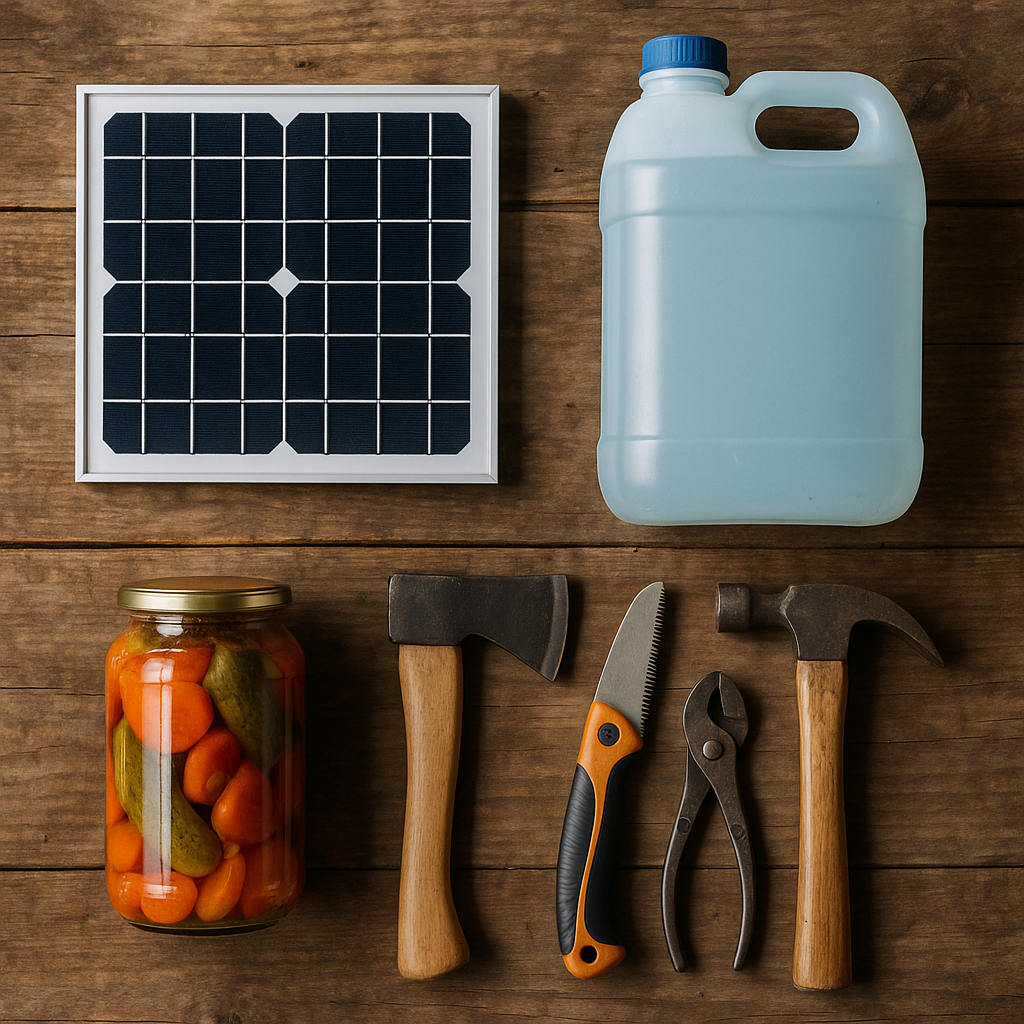
The most common mistake isn’t skipping a category, it’s building all four at once with no reserve budget or time for any of them. A more realistic sequence: secure a tested water source and at least two weeks of stored water first (nothing else works without it), then a minimum-viable power system sized to essential loads only (not the full eventual system), then food production and preservation started in parallel with whatever growing season is next, with skills built continuously alongside all three rather than treated as a separate fourth phase. Most people who transition successfully report the food system taking the longest to become genuinely self-sufficient — often 2-3 full growing seasons before production and preservation together meaningfully reduce grocery trips, which is a realistic timeline to plan around rather than a sign something’s going wrong.
Conclusion
Power, water, food, and skills aren’t independent checklist items — they interact (a water system needs power for pumps unless gravity-fed; food preservation needs either power or a properly built root cellar). Sizing and sequencing each with the others in mind, rather than treating them as four separate projects, is what makes the whole system function as intended. Source: U.S. EPA — Private Drinking Water Wells.