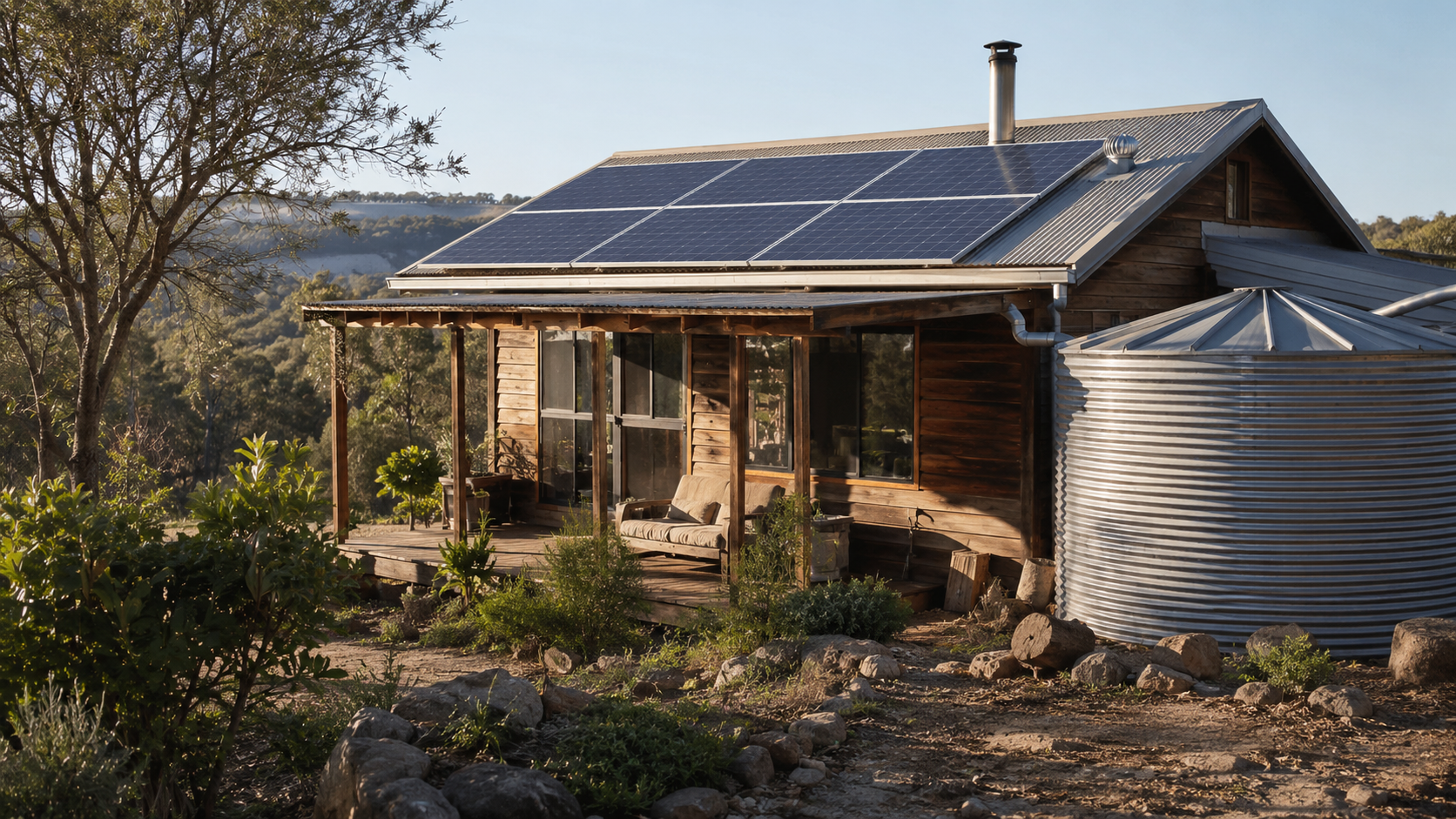
Five categories of tools cover most of the recurring work on an off-grid property: power generation, water treatment, waste management, heating, and water harvesting. Getting these right first avoids the common mistake of investing in specialized equipment before the basics are solid.
Solar Power System
A basic system needs panels sized to actual load (calculated in watt-hours per day, not guessed), a charge controller, battery storage, and an inverter to convert stored DC to usable AC. Sizing based on a real load calculation — adding up the watt-hours each device or appliance actually draws per day — avoids the common failure mode of an undersized system that can’t keep up, or an oversized one that wastes money on unused capacity.
Water Filtration
A multi-stage system (sediment pre-filter, then a filter rated for 0.2 microns or smaller to remove bacteria and protozoa, often paired with UV or chemical treatment for viruses) covers most well, spring, or rainwater sources. Relying on a single filtration stage generally leaves a gap in either particulate or pathogen removal, so understanding what a specific filter is rated to remove — not just that it’s labeled a “water filter” — matters before trusting it for drinking water.
Composting Toilet
A composting toilet eliminates the water and septic infrastructure a flush toilet requires, using a carbon additive (sawdust, coconut coir, or peat moss) after each use to manage odor and start decomposition. Legality varies by jurisdiction — some counties restrict or regulate composting toilets under health codes, which is worth confirming locally before installation, not after.
Wood-Burning Stove
A stove sized correctly for the space (undersized stoves run inefficiently at full output; oversized stoves overheat a small space and get run at inefficient partial output) provides both heat and a cooking surface, doubling its fuel value. The EPA’s own certified wood stove database lists models meeting current emissions standards — these burn significantly cleaner than older uncertified models, which matters for both indoor air quality and total wood consumption per heating season.
Rainwater Harvesting
A catchment system (roof, gutters, first-flush diverter, and storage) can theoretically collect roughly 0.6 gallons per square foot of roof per inch of rainfall, though actual yield runs lower after runoff and diversion losses. Combined with adequate storage capacity, this supplements or in some regions substitutes for well or municipal water, though system sizing should be based on regional rainfall data, not assumed.
Conclusion
These five systems — power, water treatment, waste, heat, and water harvesting — form the backbone that most other off-grid capability builds on top of. Sizing each to an actual calculated need, rather than a generic recommendation, is what separates a system that works reliably from one that falls short when it matters.