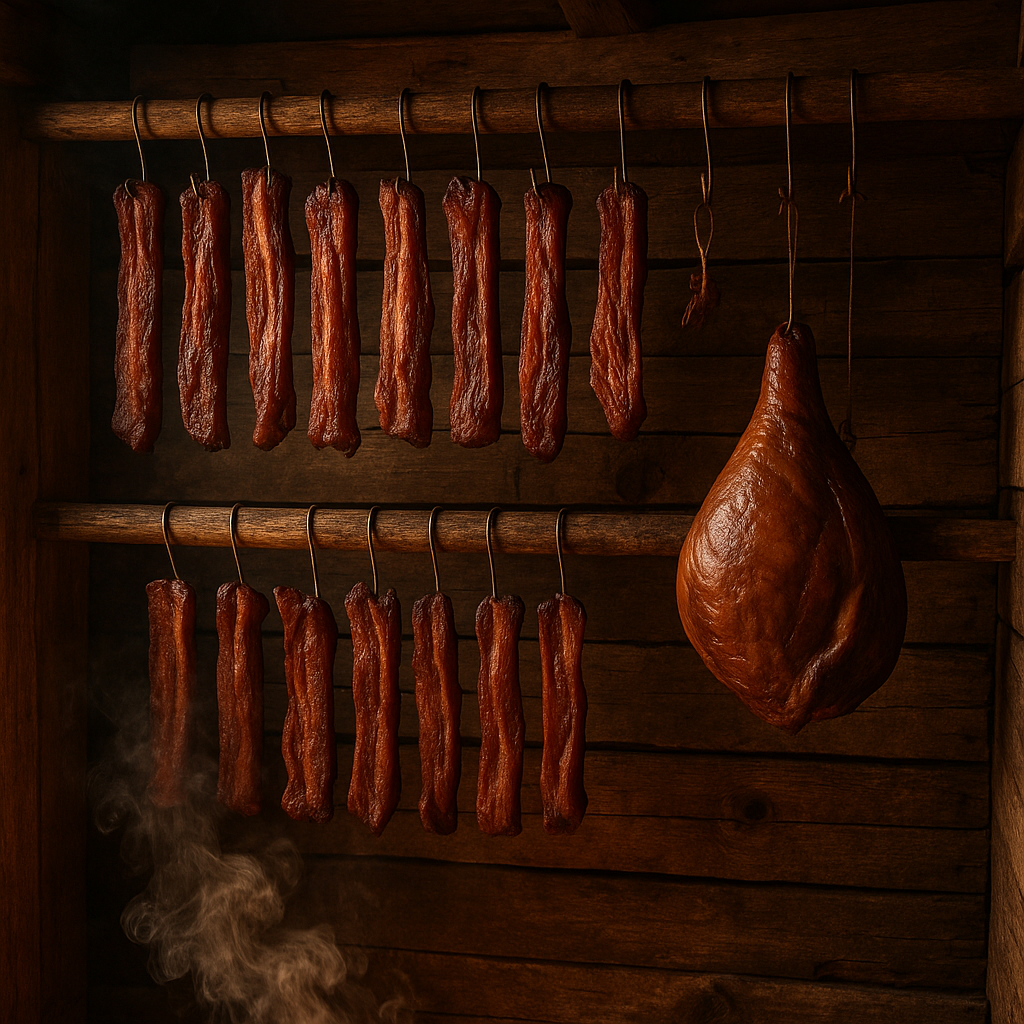
Smoking and curing are two distinct meat-preservation methods that are often combined but work on different principles: curing uses salt (and sometimes nitrates) to inhibit bacterial growth and draw out moisture, while smoking adds flavor and, at the right temperature and duration, contributes additional preservation through dehydration and antimicrobial compounds in wood smoke. A large-game harvest — a full moose or several deer in a season, or a homestead hog after processing day — is exactly the situation where this matters most: more meat than a freezer can reasonably hold, and a real preservation plan turns that surplus into shelf-stable food instead of a spoilage risk.
Smoking
Low-temperature smoking (typically 200-250°F for hot smoking) slowly cooks meat while smoke penetrates the surface, and wood species meaningfully changes the flavor outcome: hickory produces a strong, bacon-like flavor; apple and other fruit woods produce a milder, sweeter profile. Cold smoking (below roughly 90°F) adds flavor without fully cooking the meat and is typically used in combination with curing rather than as a standalone preservation method, since it doesn’t reach a temperature that reliably kills pathogens on its own.
Curing
Dry curing rubs a salt-based mixture directly onto the meat’s surface and is the traditional method for products like prosciutto and country ham. Wet curing (brining) submerges meat in a saltwater solution and is more common for corned beef and ham. Curing salt formulated for meat preservation (containing sodium nitrite, distinct from ordinary table salt) is standard for anything beyond short-term dry curing, since nitrites specifically inhibit Clostridium botulinum, the bacterium responsible for botulism — using plain salt as a substitute in a recipe that calls for curing salt is a genuine food-safety risk, not just a flavor difference.
Temperature Safety
USDA guidance requires whole cuts to reach an internal temperature of 145°F and ground meats to reach 165°F to be considered safely cooked, regardless of smoking method. Curing recipes need to be followed precisely rather than adjusted by eye — both under-curing (insufficient bacterial inhibition) and over-curing (excess nitrite) carry real risk, which is why measuring curing salt by weight rather than volume is standard practice among experienced practitioners.
Storage After Processing
Vacuum sealing removes the oxygen that most spoilage organisms need, extending refrigerated or frozen shelf life significantly beyond loosely wrapped storage. Short-term storage (a few days) works with tight plastic wrap or butcher paper in the refrigerator, but anything intended for weeks or months benefits from vacuum sealing and, for some products, freezing. A cool, humid root cellar isn’t a substitute for these methods for cured meat specifically — its target range (32-40°F, 85-95% humidity) is close to refrigerator territory but not built for the airtight seal that keeps cured product from drying out or picking up off-flavors.
How Long It Actually Lasts After Processing
“Shelf-stable” is doing a lot of work in most descriptions of cured and smoked meat, and the real numbers are shorter than the term implies for anything that hasn’t been fully dried or canned. University of Minnesota Extension’s cold-storage guidance gives concrete figures: bacon holds about 7 days refrigerated or 1 month frozen; fully cooked ham (whole or half) holds about 7 days refrigerated or 1-2 months frozen, while sliced ham drops to 3-4 days refrigerated; smoked sausage links or patties run about 7 days refrigerated or 1-2 months frozen. Hard, fully dried sausage is the outlier — it can hold indefinitely at room temperature or in the refrigerator precisely because the drying step, not the smoking, is what removes enough moisture to stop spoilage organisms. The practical takeaway for a large-game harvest: smoking and curing buy days to a couple of months, not years — vacuum sealing and freezing (or true dehydration to jerky) are what turns a smoked batch into something that lasts through a winter.
Conclusion
Smoking and curing are complementary, not interchangeable — smoking alone (at hot-smoking temperatures) is a cooking method with some preservation benefit, while curing is what actually inhibits bacterial growth for longer-term storage. Combining both, with curing salt used correctly and temperatures verified rather than estimated, is what produces a genuinely shelf-stable product rather than just a flavorful one. Storage-time figures above: University of Minnesota Extension — Storage Times for Food in the Refrigerator and Freezer.